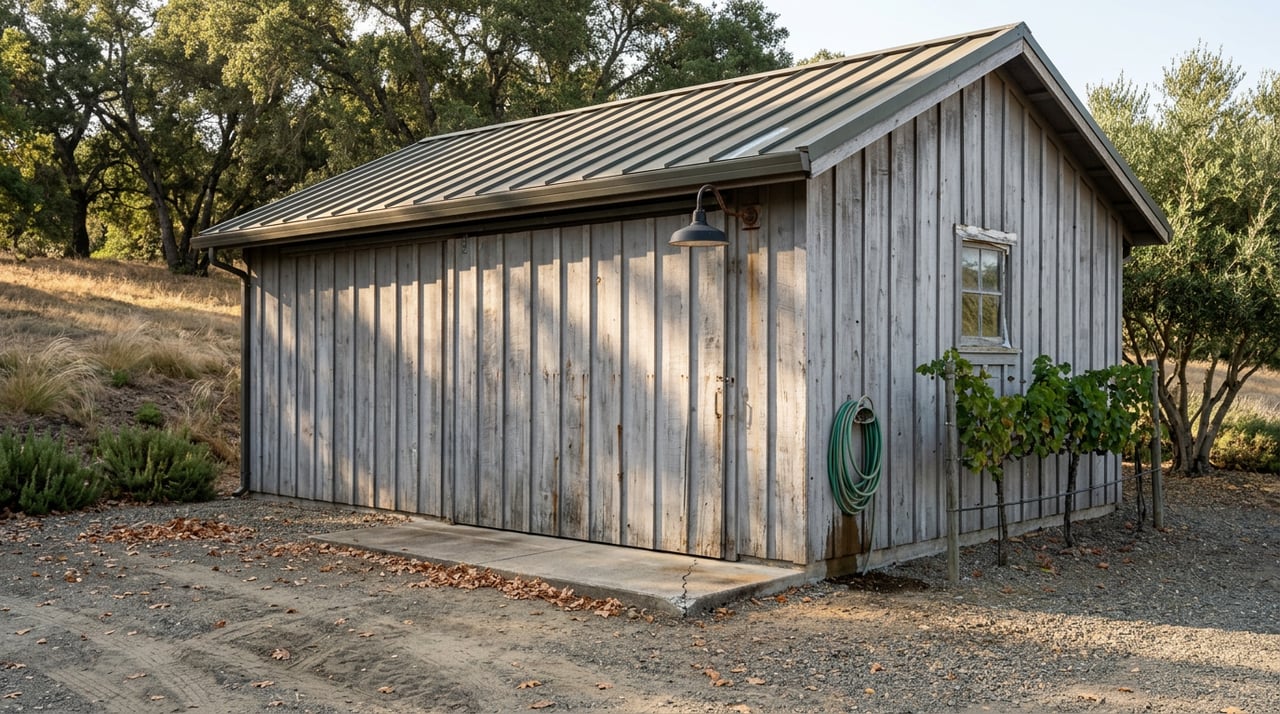
The pressure tank had a failed bladder. That single part, tucked in a utility shed fifty feet from the main house, was short-cycling the well pump every time a faucet turned on. A few yards away, a leach field showed the telltale surface saturation that signals a septic system nearing the end of its working life. In the barn, a sub-panel had never been properly bonded. None of it showed up in the listing photos. All of it showed up in the inspection, which is where Santa Ynez Valley deals are actually won or lost.
That kind of finding is not unusual on rural acreage from Ballard to Los Olivos. What has changed, and what most buyers moving from a municipal-water world do not yet grasp, is what happens after the inspection if the well itself needs replacing. Five years ago, drilling a new well on Valley land was mostly a matter of budget and a driller's schedule. Today it can also mean a hydrogeologist's sign-off and a review by a state-mandated water agency. That shift is quietly changing what an existing, documented well is worth to a buyer, and it is the piece of due diligence that deserves more attention than most Valley listings give it.
The Rule That Changed in 2022
In March 2022, Governor Gavin Newsom issued an executive order that stopped local governments from approving new water well permits in state-designated high and medium-priority groundwater basins without written verification from the basin's Groundwater Sustainability Agency that the new well would not undermine the basin's sustainability plan. The Santa Ynez River Valley Groundwater Basin is one of those medium-priority basins.
Santa Barbara County followed with its own ordinance that May, and it tightened the process further. Where a new well permit had previously been what county staff described as an over-the-counter transaction, the county now requires a licensed hydrogeologist, or a licensed geologist with hydrogeological expertise, to confirm that a proposed well will not reduce the output of neighboring wells before the county will issue a permit. The Santa Barbara Independent covered the vote and the pushback from the Board of Supervisors, some of whom worried the language was too loose for large users and others who worried it was too restrictive for farmers.
There is an important carve-out. Ordinary domestic wells pumping less than two acre-feet of water a year, the kind that serve a single household rather than a vineyard block or a second irrigated pasture, are exempt from the new review. That exemption matters enormously for how you should read a Valley listing. A modest domestic well serving one home is still a fairly straightforward permit. A well meant to irrigate new plantings, fill a pool, or serve a guest house and a barn on top of the main residence is the kind of higher-volume use that can now trigger the hydrogeologist review and the wait that comes with it.
Put simply: if your plan involves expanding water use on a Valley property, budget time for a process that did not exist before 2022. If your plan is to buy a property where the well, the pump, and the permit history are already documented and working, you are buying something that is measurably harder to recreate today than it was when the current owner built it.
The well is no longer a line item you fix after closing. On Valley acreage, it is increasingly the asset you are actually buying.
Two Agencies, One Basin
The Santa Ynez River Valley Groundwater Basin is managed by two separate Groundwater Sustainability Agencies, and which one governs a given parcel depends on where in the Valley it sits. The Central Management Area GSA was formed by the Santa Ynez River Water Conservation District, the City of Buellton, and the Santa Barbara County Water Agency, and entered into its current joint powers agreement in November 2023. The Eastern Management Area GSA, covering the portion of the basin around Solvang, was formed by the same water conservation district along with the City of Solvang, the county water agency, and the district's Improvement District No. 1, with its own joint powers agreement effective July 2024.
For a buyer, the practical takeaway is not the org chart. It is that groundwater sustainability planning in the Valley is being run at the sub-basin level, town by town, rather than as one blanket policy. The Santa Ynez River Valley Groundwater Basin's public site posts legal notices and updates as the sustainability plans evolve, and it is worth a look before you get deep into escrow on any parcel where you are counting on expanding water use.
The Santa Ynez basin is not the only one under this kind of scrutiny. Santa Barbara County has five groundwater basins flagged for moderate to high overdraft concern: Cuyama, Carpinteria, Montecito, Santa Ynez, and San Antonio Creek. The county's own groundwater basin resource page is the clearest starting point for anyone who wants to see how the Santa Ynez basin's boundaries and management areas actually map onto specific parcels.
What the Second Quarter Actually Shows
The Valley's Q2 2026 numbers make a case for looking below the regional average. Across the broader Santa Ynez Valley region, the median sales price came in around $1.29 million with an average of 56 days on market, 127 active listings, and only one sale above $5 million for the entire quarter. That is the headline figure most portals will show a buyer. It is also close to useless for deciding what a specific offer should look like, because the towns underneath it behave nothing alike.
Town | Q2 2026 Median Price | Q2 2026 Days on Market |
|---|---|---|
Los Olivos | $2.84 million | 9 |
Ballard | $3.48 million | 26 |
Solvang | $1.4 million | 35 |
Buellton | $905,000 | 46 |
Santa Ynez | $1.73 million | 75 |
Los Olivos and Ballard, the Valley's two smallest and most established wine-country pockets, are moving fastest despite carrying the highest median prices. That pattern is consistent with what we see in these micro-markets directly: well-documented estates with working infrastructure and settled permit histories draw competing offers quickly, because a buyer who has done the water-and-septic homework does not want to lose a property that already checks that box. Santa Ynez proper, sitting at 75 days on market, tends to carry a wider mix of raw acreage and older rural parcels where wells, septic systems, and outbuildings have less documentation, which lengthens the due diligence period on both sides of the table.
Buellton's much lower median and shorter runway line up with its status as an incorporated city and a formal partner in the Central Management Area GSA, which typically means more parcels sitting closer to municipal water infrastructure rather than depending entirely on a private well. That is a meaningfully different kind of purchase than acreage further out in the unincorporated Valley, and it is worth asking directly, before you tour, whether a given address is on a private well or a municipal connection.
What a Rural Inspection Actually Turns Up
A standard home inspection is not built to evaluate a well or a septic system in depth, which is exactly why Valley-experienced inspectors recommend pairing it with a dedicated septic certification that includes tank pumping and a laboratory water test for the well. On a recent local inspection, the findings included a well pressure tank with a failed bladder short-cycling the pump, a leach field showing surface saturation, and a barn sub-panel that had never been properly bonded. None of those are visible from a listing photo or a drive-by.
The cost math is worth having in front of you before you negotiate. A professional well inspection generally runs $300 to $600, and a water quality test for bacteria and nitrates typically costs $50 to $350. On the replacement side, drilling a new well on Valley land can run $5,000 to $15,000 or more, with deeper wells in harder rock exceeding $20,000, while a conventional septic system installation runs roughly $3,500 to $15,000, and an alternative or engineered system for poor-draining soil can reach $10,000 to $25,000 or beyond. Combined, a new well and septic system from scratch can land anywhere from $10,000 to $35,000, before accounting for the permitting timeline discussed above.
That is the number that should reframe how you read a listing. A property with an aging but functional, fully documented well and septic system is not a liability to be priced down. It is infrastructure that would cost real money and real time to replace under today's rules, and that fact belongs in your offer strategy as much as square footage or acreage does.
Before You Write the Offer
- Ask whether the property is on a private well or a municipal connection, and if it's a well, request the original well completion report showing depth, casing, and the driller's findings
- Request a current septic certification that includes tank pumping, not just a visual walk-through
- Order an independent water quality test for bacteria, nitrates, and any agricultural runoff concerns specific to the parcel's surroundings
- Confirm whether the well's documented use falls under the two acre-foot domestic exemption, or whether any planned expansion, additional structures, new plantings, a pool, would push it into hydrogeologist-review territory
- Identify which Groundwater Sustainability Agency, Central or Eastern Management Area, governs the parcel, since that determines who you would be dealing with on any future permitting
A Few Common Questions
Does every new well in the Valley now require agency approval? No. Ordinary domestic wells pumping less than two acre-feet a year for a single household are exempt from the hydrogeologist review. The review applies to higher-volume uses, which most often means agricultural irrigation, expanded landscaping, or additional structures on a parcel.
Does this affect properties that already have a working well? Not directly. An existing, permitted well in current use is not subject to a retroactive review. The friction shows up if you want to drill a new well or meaningfully expand the use of an existing one.
Is the process the same in Solvang as it is in Buellton? The underlying state rules are the same, but the two towns sit under different Groundwater Sustainability Agencies, the Eastern Management Area around Solvang and the Central Management Area around Buellton, each with its own sustainability plan and its own point of contact.
If you are looking at Valley acreage this season, the well and septic questions deserve the same attention you would give the view, the vines, or the barn. Our team spends as much time on due diligence and infrastructure history as we do on presentation, because on rural property, that groundwork is what protects your offer and your closing timeline. Explore current listings across the Santa Ynez Valley, review our buyer's guide for the full due diligence checklist, or reach out to Alemann & Associates directly to talk through a specific parcel before you write an offer.