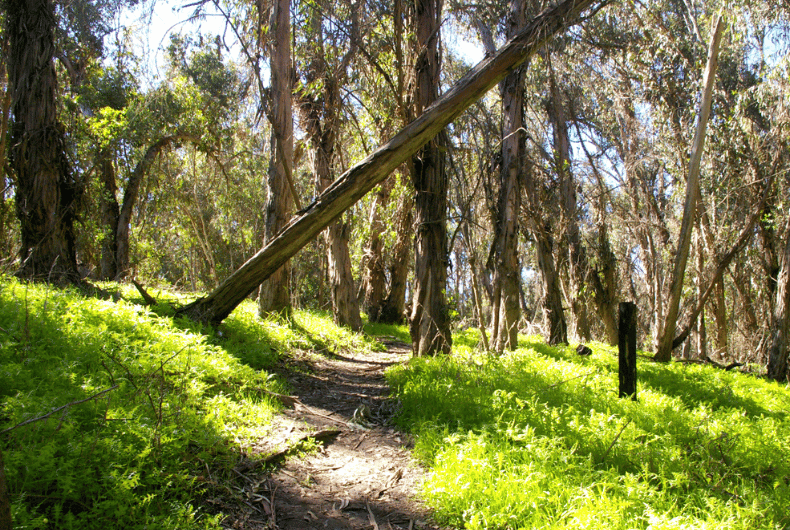
The story most people know about Ellwood Mesa goes like this: walk the half mile from the parking lot off Hollister Avenue, step into the eucalyptus grove, and look up. Thousands of monarch butterflies hang in clusters that look like dead leaves until the morning sun warms them enough to fly. That version of the grove is real. It has also, for the last two winters, been mostly absent.
On January 5, 2026, the biologists who count monarchs at Ellwood every two weeks found exactly two butterflies. The winter before that, the count across all of Ellwood's monitored sites came to three. Those numbers matter more than they might seem, and understanding why changes what a walk out to the grove is actually for this year.
The Grove Twenty Years Built a Reputation On
Ellwood Mesa takes its name from Ellwood Cooper, who settled the land in 1870 and planted olives, walnuts, grapes, almonds, oranges, lemons, and Japanese persimmons across what's now Goleta. The eucalyptus trees he planted as windbreaks turned out to do something he never intended: they became one of the most reliable overwintering sites in California for western monarch butterflies, which need eucalyptus canopy's filtered light and wind protection to survive the winter without freezing.
The 137-acre Ellwood Mesa Open Space, which includes the 78-acre eucalyptus grove and windrow habitat where the monarchs cluster, borders the adjoining Sperling Preserve, secured in the 2000s with a $5 million gift from philanthropist Peter Sperling and purchased by the Trust for Public Land before being handed over to the city to keep the land from being developed. That history is why Ellwood shows up on the same short list as Pismo Beach and Pacific Grove when people talk about where to see California's monarch migration. For twenty years, that reputation held.
The Two Butterflies That Made the News
Then it didn't. Here's what the count has looked like at Ellwood over time, according to biologist Charis van der Heide, who has coordinated the Xerces Society's Western Monarch Count in the area:
When | Monarchs counted at Ellwood |
|---|---|
About 20 years ago | Roughly 50,000 |
Winter 2024-2025 | 3 |
January 5, 2026 | 2 |
What makes the recent numbers sting isn't just the size of the drop. It's what was happening an hour up the coast around the same time. That same month, counters at Pismo Beach recorded more than 14,000 butterflies while Ellwood's count sat at two. Two coastal groves, similar habitat, similar climate, and one of them nearly full while the other was functionally empty. That gap is the reason scientists describe monarch populations as bouncy rather than simply declining, and it's also the reason nobody can promise you butterflies if you walk out to Ellwood this winter. You might see thousands. You might see two.
Statewide, the pattern backs up what happened locally. After three consecutive years with more than 200,000 overwintering monarchs counted across California, the 2024-2025 Western Monarch Count found a peak population of just 9,119, the second-lowest total recorded since tracking began in 1997. The Xerces Society's own accounting of that season notes that monarch clusters were "notably absent" from Ellwood, with only three individual monarchs observed across the site's multiple locations. The City of Goleta's own numbers put the long-term decline in the western monarch population at 95 percent since the 1980s.
A Handful of Volunteers Are the Reason Anyone Still Knows the Numbers
None of this data collects itself. Every two weeks during overwintering season, volunteers with the Xerces Society's Western Monarch Count walk Ellwood's sites in the early morning, before it warms past 55 degrees and the butterflies start moving, and count what's there by hand. Van der Heide has done this work at Ellwood and nearby sites for years. In a KCBX report, she called the current count "incredibly low" and offered this comparison: "Just for context, maybe 20 years ago there were 50,000 butterflies just in one spot at Ellwood Mesa."
On weekends, the volunteers who staff the grove itself are docents with the City of Goleta's Monarch Butterfly Docent Program, which the city says it is actively revitalizing. One of them, a Goleta resident named Craig Wakamiya, spends his Saturdays and Sundays explaining monarch biology to whoever walks up, repeating the same information to new visitors without seeming to tire of it. A Blue Dot Living article quotes Wakamiya on what happens when the butterflies eventually leave the grove each spring: they fan out "perhaps a hundred miles" looking for milkweed to lay eggs on, since none grows in the eucalyptus grove itself. Docents are typically out at the grove Saturdays and Sundays from 11 a.m. to 2 p.m., weather permitting, from mid-November through mid-February.
What the City Actually Changed on the Ground
The response to the population crash hasn't just been counting and hoping. In 2024 and 2025, the nonprofit Sage Trail Alliance completed a restoration project inside the main grove, removing built-up sediment and constructing small earth-and-rock weirs to slow drainage and create stepped pools of water. The idea is straightforward: monarchs need humidity and a water source to survive clustered together through winter nights, and the grove's natural drainage had degraded to the point where it wasn't holding water the way it used to. The same project rerouted some viewing trails to reduce erosion and keep visitors away from specific trees under stress.
The city has also installed a Motus wildlife tracking station at Ellwood, part of an international radio telemetry network that lets researchers follow individually tagged monarchs as they move between overwintering sites. It's a small piece of equipment with an outsized purpose: instead of guessing whether the monarchs that show up at Ellwood in a given year came from the same population as the year before, biologists can now trace individual movement patterns directly.
The Count Everyone Will Be Watching This October
The city's tracking page for the 2026-2027 overwintering season is currently blank, with a note that the first chart will post in early October 2026. That's not far off. When it does, it will answer the question this piece can't: whether Ellwood's population continues the crash that produced two butterflies in January, or whether it starts to look more like Pismo Beach's rebound to 14,000 the same winter. Either way, this fall is the one where the numbers get written down again, and the volunteers doing that work are the same people who'll be at the grove on weekends explaining what they're seeing to whoever walks up.
Walking Out to See It Yourself
The grove sits inside Ellwood Mesa Open Space, reached by a parking lot across from Ellwood Elementary School at 7686 Hollister Avenue, or from the Sperling Preserve lot at the end of Coronado Drive. From either lot it's roughly a half mile of trail to the main viewing area, marked along the way. A few things worth knowing before you go:
- Admission is free, though the city accepts donations to support the docent program.
- Dogs are welcome on leash, and owners are expected to pack out waste, since off-leash dogs and litter are two of the more avoidable pressures on the habitat.
- Skip the visit right after rain. The unpaved trails turn to mud quickly, and the ground stays soft longer than you'd expect this close to the coast.
- Bring binoculars if you have them. The clusters sit high in the eucalyptus canopy and are easy to mistake for dead leaves from the ground.
- If you visit on a weekend between mid-November and mid-February, look for a docent near the trail's viewing area. They'll usually know exactly which trees have activity that day.
Whatever the count turns out to be this winter, the walk itself hasn't changed. It's still a quiet half mile through a grove that exists because a previous generation of residents decided it was worth protecting, and it's still one of the better places in Goleta Valley to spend a slow weekend morning. This year, though, you're not just visiting a postcard. You're watching a piece of local science play out in real time, and the emptiness, if that's what you find, is as much a part of the story as the wings.
If Ellwood Mesa is the kind of place that makes you want to know more about daily life in this part of the coast, our Goleta Valley neighborhood guide covers the rest of what makes this stretch of the South Coast worth exploring. And if a walk through Ellwood ever turns into a bigger question about buying or selling nearby, the team at Alemann & Associates is always glad to talk it through.
Picture: Noozhawk.com
This article is general information, not legal, tax or financial advice. Consult a qualified professional about your situation.