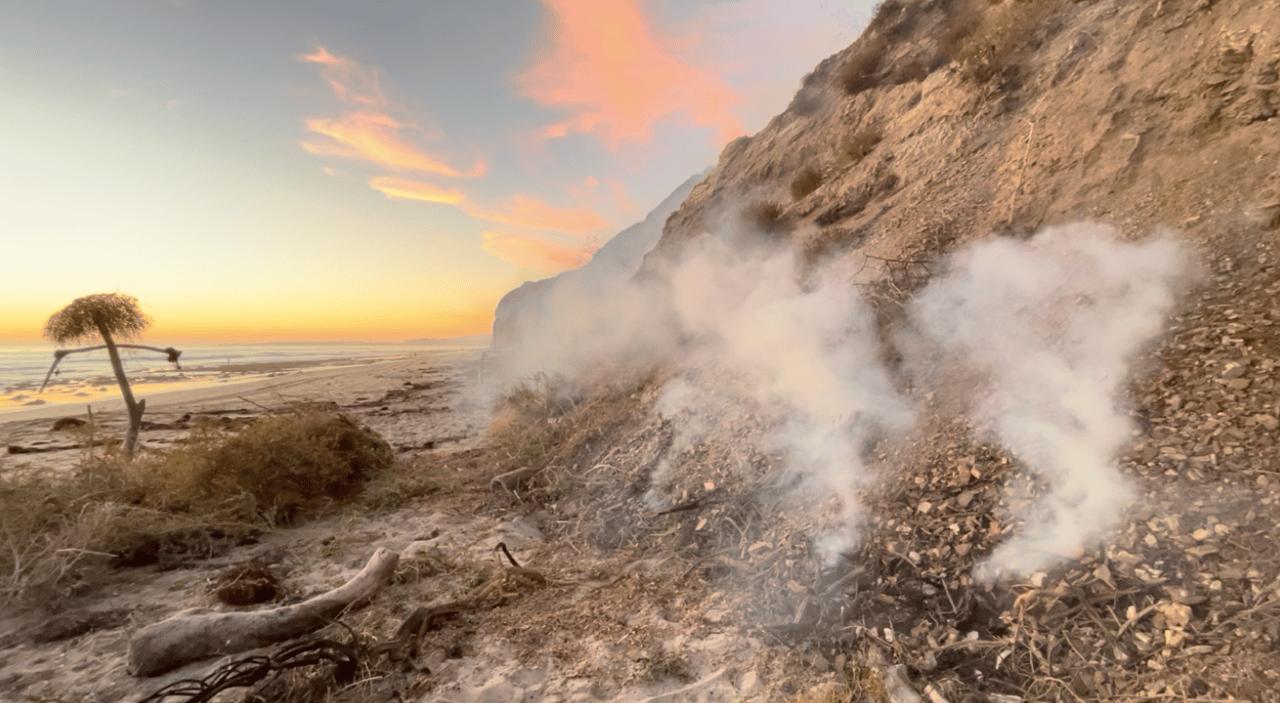
On the morning of April 23, 2026, someone walking the bluffs above Hope Ranch Beach looked up and saw smoke curling off the cliff face. A wildfire camera on UC Santa Barbara's campus, part of the statewide ALERTCalifornia monitoring network, caught the same plumes rising along the coastline. A Santa Barbara County Fire engine and battalion chief were soon on scene, working through a question crews here have answered more times than most people realize: is this a fire, or is it the volcano again?
There is no volcano in Santa Barbara County. What there is, tucked into the cliffs along this stretch of coastline, is a chemical reaction old enough to have been described in writing before the United States had a president named after either Roosevelt. Most residents know it as a curiosity, the kind of thing you mention to houseguests when smoke shows up where it shouldn't. Fewer know that the pattern behind it says something real about how this coastline behaves, which is worth understanding if you spend any time walking, riding, or living along it.
Not a Volcano, but Not New Either
Santa Barbara County Fire spokesperson Michael Gray put it plainly after the April event: he has simply always known it as the Hope Ranch volcano, the same way generations of residents before him did. The nickname sticks because it looks the part. Smoke rises from cracks in the rock, sometimes accompanied by a sulfur smell, sometimes with enough heat to ignite the dry brush around it. But geologists who have actually studied the site describe something closer to a slow-motion chemical fire than anything volcanic.
The phenomenon isn't new. A letter from 1795 describes this same stretch of coastline in terms that could pass for a modern fire department log, noting that the ground burns "continuously in more than 30 places, like geysers that exude dense smoke." That's more than two centuries of the same rock doing the same thing, long before anyone thought to give it a nickname.
Three Ingredients, One Coastline Rearranging Itself
The mechanism has been explained differently by different people over the decades, which has muddied the nickname further. Some reports call it a solfatara, a term technically reserved for volcanic steam vents. But the scientists who have walked the site tell a more grounded story. UCSB Geology Professor Emeritus James Boles has studied the bluffs directly and traces the heat to oxidation, not magma. As he explained it, these reactions are called exothermic reactions and they give off heat, and under the right conditions that heat is enough to ignite organic material trapped in the rock.
The rock in question is part of the Monterey Formation, the same petroleum-rich shale responsible for the offshore oil that has long been pumped along this coast. That shale holds iron sulfides and hydrocarbons that stay chemically stable as long as they're sealed away from air. UCSB professor David Valentine, whose research focuses on microchemistry and geochemistry, explained the trigger simply: when oxygen penetrates into the bluffs, it reacts with these minerals. Erosion is what lets that oxygen in.
That's the detail easy to miss in the "just a quirky local thing" version of this story. The volcano doesn't appear at random spots along the coast. It appears where the bluffs are actively eroding, where a landslide or a slumping section of cliff has freshly exposed rock that had been sealed for years. The 2006 flare-up traced back to a landslide roughly eighteen months earlier that peeled back enough shale to expose the buried hydrocarbons to air and sunlight. Every time the volcano smokes, it's advertising that a piece of the bluff has moved. The smoke isn't the story. The erosion underneath it is.
A Rhythm That's Consistent but Never on Schedule
The site has flared with real regularity since the 2006 event, though never on any fixed calendar. Santa Barbara Independent reporting on the April 2026 incident noted prior flare-ups in 2021, 2020, 2019, and 2017, on that same stretch of bluff. Add the well-documented 2006 event, and 2024 coverage from local outlets describing another round of smoke and small brush ignition, and the pattern becomes clear: this isn't a one-time anomaly, it's a site that reliably does this again whenever the conditions line up.
What varies is the timing, not the mechanism. Some years bring nothing visible at all. Others bring multiple sightings within a season. County officials have noted the interval can range from a single flare-up to a run of monthly sightings when a section of cliff is actively slumping. The rock's chemistry hasn't changed since 1795. What changes is how much of it erosion has exposed in any given stretch of time.
Hope Ranch isn't the only place along this coast where the same combination of shale and erosion has shown its hand. A similar, smaller event was documented at the base of a remote bluff near More Mesa, the open coastal land just east of Hope Ranch, decades before the 2006 incident. Same formation, same reaction, different mile marker.
What Actually Happens When It Flares Up
For residents, the practical version of this story is short. When smoke is reported, Santa Barbara County Fire sends an engine and typically a battalion chief to assess the site, confirm it isn't a structure or vegetation fire spreading beyond the bluff, and monitor until it burns itself out. In the April 2026 incident, crews traced the specific ignition to a smoldering PVC drainage pipe embedded in the cliffside, extinguished it, and confirmed no structures were threatened, though residents were asked to stay clear of the immediate area while crews worked.
That's been the consistent playbook across every documented flare-up, from the 2006 event where sprinklers ran around the clock to douse a fifty-foot section of bluff, to the more contained incidents in recent years that fire crews now recognize on sight. Battalion Chief Adam Estabrook has described the same three-part chemistry to reporters covering more recent flare-ups: heat from the rock, fuel from the trapped oil, and oxygen from the eroding cliff face. Once crews confirm that mix isn't threatening anything beyond the bluff itself, the standard response is to let the reaction run its course rather than attempt to extinguish rock that's chemically primed to keep smoldering.
If you're out walking near the bluffs and see smoke, the guidance hasn't changed in twenty years: stay back from the edge, don't attempt to investigate the source yourself, and let county fire confirm what's happening. It almost certainly isn't an emergency. It's almost certainly the same reaction that's been showing up here since before Santa Barbara had paved roads.
The Bluffs Are Always Telling You Something
Most neighborhoods don't have a nickname for their own geology. Hope Ranch does, and it's earned it honestly. Every time smoke rises from those cliffs, it's a visible marker of the same slow process shaping this coastline year over year: erosion exposing rock that's been waiting, in some cases for centuries, for enough air to finally react. The next time a plume shows up along the bluffs above Hope Ranch Beach, you'll know it's not a mystery. It's the coast doing what it's always done here, just loudly enough this time for someone to notice.
If you're curious about other corners of daily life in Hope Ranch, from the equestrian trails to the coastline itself, our Hope Ranch neighborhood guide is a good place to keep exploring. And if you ever want to talk with someone who knows this stretch of coast well, Alemann & Associates is always happy to hear from you. Contact us anytime.
Photo Credit: Hugh Margerum