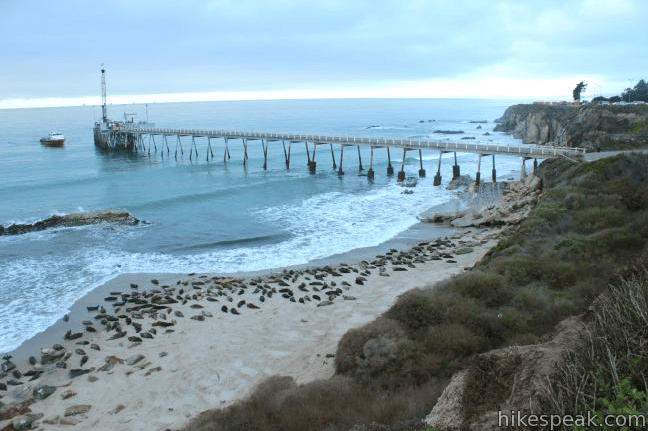
Every December 1, the same thing happens on the Carpinteria Bluffs. Signs go up in English and Spanish. A stretch of beach at the base of Casitas Pier gets roped off. Dog owners reroute to the bluff top trail. If you've lived in Carpinteria more than a season, you've walked past this closure without much thought. It happens every year. It ends every May 31. It is, by now, part of the town's rhythm.
This year it's landing differently, because for the first time in decades, the closure overlaps with a live decision about what gets built on the land right next to it.
The Ordinance You Already Know
The mechanics haven't changed. Carpinteria City Ordinance #470 closes the rookery beach from December 1 through May 31 each year, covering roughly 750 feet east and west of Casitas Pier and extending 1,000 feet out to sea. The bluff top trail and the overlook stay open the whole time. If you want the short version for your calendar:
- Closure window: December 1 through May 31, annually
- Closed area: about 750 feet east and west of Casitas Pier, plus 1,000 feet offshore
- What stays open: the bluff top trail and the Coastal Vista Trail overlook
- Recommended parking: 499 Linden Ave, with a roughly 1.3-mile walk to the rookery overlook on flat but unpaved terrain
- Enforcement: the federal Marine Mammal Protection Act applies year-round, with fines up to $10,000 per violation
That much is settled and has been for years. What's not settled is whether this closure, as written, is even enough anymore.
A Slide That Didn't Start This Year
The Santa Barbara Independent reported that the Carpinteria rookery is one of only two remaining harbor seal breeding and pupping grounds left on the Southern California mainland. In 2004, volunteer counters tallied 365 seals there. By 2023, that number had fallen to 158 adults. One longtime Seal Watch volunteer, who has worked a two-hour shift every Monday for close to two decades, has watched the colony shrink from around 400 to about 100 over that stretch.
This year added a new data point to that trend. Susan Mailheau of the nonprofit Save Our Seals told the Santa Barbara Independent in April that stress hormones interfere with seal reproduction, and that the rookery had produced roughly half its normal pup count this season. That's not a one-year dip. It's a line that's been sloping the same direction for twenty years, through multiple mayors, multiple city councils, and one earlier attempt to fix it that went nowhere.
In late 2024, the city's Harbor Seal Advisory Committee recommended closing the beach entirely for three years, treating it as a controlled test of whether removing human presence would let the population recover. The California Coastal Commission and the city itself both declined, citing the cost of staffing a year-round closure, estimated at roughly $380,000 annually for rangers and reporting. The committee is still pushing for approval. The Coastal Commission, whose mandate is protecting public beach access statewide, hasn't been persuaded that a longer closure is warranted yet.
That's the part worth sitting with: the agency that decides how much protection this rookery gets isn't Carpinteria's city council. It's a state commission weighing seal welfare against public access rights up and down the whole coast, and so far it has sided with access twice.
The Parcel Next to the Overlook
While that debate has stalled, a different kind of pressure showed up on the bluffs themselves.
In March 2026, a development team proposed "The Farm," a 191-unit housing project on 27 acres at 5885 Carpinteria Avenue, the site currently occupied by the Tee Time driving range and a small organic farm. The parcel sits beside the Carpinteria Bluffs Nature Preserve and within view of the seal rookery overlook. The plan calls for 94 townhomes and 97 single-family homes, with 39 units set aside as income-restricted housing managed by the nonprofit People's Self-Help Housing.
The project has moved forward under California's builder's remedy provision, which lets developers bypass certain local zoning rules if a city's housing plan hasn't been certified by the state and the project includes a share of affordable units. An April 9 open house at Carpinteria Community Church drew roughly 200 residents, and a parallel gathering held the same night by Citizens for the Carpinteria Bluffs turned out opponents at the Carpinteria Woman's Club next door.
Citizens for the Carpinteria Bluffs isn't a new voice in this fight. The group formed in the 1990s and has spent decades helping acquire land that's now protected, including the Nature Preserve itself and Viola Fields. Its president, Patrick Crooks, has said there is much worth saving on the parcel. Former Carpinteria mayor Fred Shaw, who was on hand at the open house, put the history in context in the Santa Barbara Independent: campaigns to save the bluffs go back to the 1970s and 80s, and "we've done fairly well" holding the line so far.
Susan Mailheau, watching from the seal advocacy side, connected the two issues directly. She told the Independent she worries the seals could be pushed out if the housing proposal moves forward on the parcel just north of the rookery.
The city's public scoping meeting on The Farm ran through early July, and a draft environmental impact report is now in preparation. That review, once released, will be the next real test of how seriously the project's effects on the rookery get weighed.
A Second Proposal, a Different Reception
Not every bluffs project is getting the same pushback. A separate proposal at 6185 Carpinteria Avenue, next door to Procore's offices, would convert two vacant office buildings into 31 units of housing and live-work space. City councilmembers gave it soft support in July, a notable contrast to the reception The Farm received just months earlier.
The difference seems to come down to footprint. The Procore-adjacent project reuses existing structures rather than clearing open land, and its developer, Peter Lewis, framed it as filling a housing-jobs imbalance without disturbing anything currently undeveloped. Two other housing proposals for the bluffs area have failed to move forward since 2013, largely over concerns that any new development would open the door to more. This one, so far, hasn't triggered that same alarm.
Seen together, the two projects tell you something about how this town actually decides what belongs on its coastline: it's less about housing itself and more about whether a proposal touches open ground the community has already fought to protect.
Walking Past the Signs This December
None of this changes what you'll see on the trail this winter. The tape goes up December 1. The overlook stays open. Seal Watch volunteers, working under Save Our Seals, will be out from November through May doing the same job they've done for years: keeping beachgoers and off-leash dogs at a respectful distance and answering questions from the Coastal Vista Trail. If you're looking for a way to get more involved than a weekend walk, the group is actively recruiting new volunteers for exactly that role.
What's different is the context around the fence line. This is the first pupping season to run alongside an active environmental review for a 191-unit project on the land right next to the rookery, following a year in which pup numbers were already down by roughly half. The seasonal closure was written to manage human foot traffic on the sand. It wasn't written to account for a construction timeline on the bluff above it. Whether that gap matters will likely show up in the draft EIR expected in the coming months, and in whatever the Coastal Commission decides the next time a longer closure comes up for a vote.
For now, the practical version is simple: same dates, same boundaries, same trail. But if you've walked past those signs every December without a second thought, this is the year that habit is worth breaking, at least long enough to read the meeting notices posted at Carpinteria City Hall alongside them.
Carpinteria's coastline has always asked its residents to pay attention in ways that go beyond a walk on the beach. If you're curious how neighborhood-level shifts like this one connect to property values, buyer interest, or what to expect if you're weighing a move within Carpinteria's beach-adjacent streets, Alemann & Associates tracks these local details as part of how we advise clients across Santa Barbara County. Reach out anytime to talk through what's happening in the neighborhoods you care about.
Photo Credit: hikespeak.com
This article is general information, not legal, tax or financial advice. Consult a qualified professional about your situation.